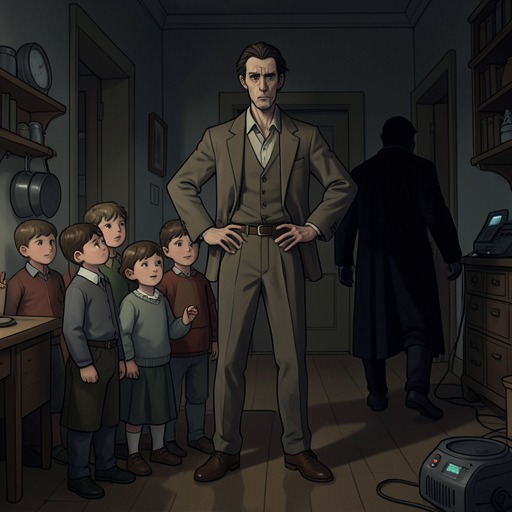
Puddleglum’s defiance of the Green Witch
The Silver ChairPuddleglum’s defiance of the Green Witch is the decisive break in her enchantment of Jill Pole, Eustace Scrubb, and Prince Rilian. As the Witch’s music and arguments make the Overworld, Narnia, and Aslan seem like inventions, Puddleglum refuses to let uncertainty dictate his allegiance: even if the world he remembers were only imagined, he declares, it would be worth choosing over the Witch’s bleak kingdom. His refusal restores the others’ clarity and turns a conversation designed to end in submission into the beginning of their escape.
The Witch’s assault on memory
The confrontation reaches its crisis when the Witch asks Jill to explain the other world. Jill’s thoughts briefly range over Experiment House, her home, radio sets, cinemas, cars, aeroplanes, ration books, and queues, but these familiar things seem distant. Under the full strength of the enchantment, she cannot remember their names and does not recognize that she is being bewitched. It becomes a relief to accept the Witch’s suggestion that the other world must have been a dream.
The pressure extends beyond Jill. When the Witch insists that no world exists except her own, the others echo her claim. Puddleglum, however, struggles to articulate what they mean by a world and holds onto particular memories rather than an abstract argument: he recalls Narnia and the Overworld, the stars, and the sun’s course from sea to mountains and across the midday sky. His account jolts the others into recognition. Prince Rilian realizes that they have all seen the sun and identifies their lapse as a period of dreaming, but the Witch’s influence soon closes over them again.
Jill then recovers the thought she has been struggling to hold: Aslan exists. The Witch answers by treating the sun and Aslan as childish imitations of lamps and cats, and by insisting that the world beneath the ground is the only real one. The Prince and the children stand with lowered heads and dulled attention. The Witch’s argument is not merely that they are mistaken; its force lies in making their memories feel less credible than the story she supplies.
The fire and the return of clarity
At the height of the enchantment, Puddleglum walks to the fire and stamps on it with his bare foot, grinding part of it into the ashes. The act is deliberate: he knows it will hurt, but judges the pain bearable. The diminished fire weakens the sweet, heavy smell that had accompanied the Witch’s influence; the change clears the others’ minds enough for the Prince and children to lift their heads and open their eyes.
The Witch’s response exposes the threat beneath her soothing manner. She abandons her sweet tones to shout at Puddleglum and threaten him if he touches the fire again. The pain also gives Puddleglum a moment of perfect clarity. His action therefore breaks the enchantment through a concrete interruption: it alters the setting of the scene, provokes the Witch into revealing her hostility, and gives him the clear-minded interval in which to answer her.
Choosing the imagined world
Puddleglum does not try to prove every part of the Witch’s account false. He grants, hypothetically, that the others might have dreamed or invented trees, grass, the sun, moon, stars, and Aslan. But that concession does not produce the conclusion the Witch wants. If her underground kingdom is the only world, he argues, it is a poor one; even an invented world of the kind they remember seems more important and worthier than the one she offers.
This reasoning turns the Witch’s dismissal of their beliefs against her. She calls their account make-believe and presents her realm as reality; Puddleglum answers that reality, as she describes it, is not automatically deserving of allegiance. He commits himself to the play-world even if it is only a play-world, to Aslan’s side even if Aslan is not there to lead it, and to living as like a Narnian as possible even if Narnia does not exist. He and the others, he says, will leave the Witch’s court and search for the Overworld, despite his expectation that their lives will probably be short.
Consequences and significance
Puddleglum’s declaration gives the others a renewed basis for resistance. Eustace and Jill cheer him, while Prince Rilian abruptly warns them to look at the Witch. The scene thus ends not with the Witch’s proposed sleep and submission, but with the group alert to immediate danger and committed to leaving her court.
The episode makes loyalty a choice sustained even under radical doubt. Puddleglum’s certainty is not presented as the product of an effortless proof: he remembers what he has experienced, accepts the possibility that he could be wrong, and still judges the values of Narnia and Aslan superior to the Witch’s account of reality. The fire-stamping gives that judgment physical consequence, while his argument converts a moment of restored clarity into a decision shared by the others.